The Modern Mattress Playbook: Sizes, Types, and Support
A mattress is the one purchase that gets reviewed every night, by your back, your shoulders, and your patience. When it’s right, sleep feels easy. When it’s wrong, even the nicest bedroom starts to feel like it’s missing something.
That’s exactly what this playbook is for: cutting through the noise and helping you choose with confidence. No showroom theatrics, no overcomplicated jargon, just the essentials that make a mattress feel right in real life. The goal is simple, a setup that supports the way you sleep, fits the space you live in, and feels good long after the “new mattress” excitement fades, right down to the bedding.
Table of Contents
What are the Main Types of Mattress?

Foam
A foam mattress is made entirely from foam layers, no coils, no springs. Instead, different foams are stacked to create a “comfort system” on top (the plush, pressure-relieving part) and a denser support core underneath (the structure that keeps your body from sinking too far).
Types of Foam (and how they feel)
a) Memory foam: Slow-response, “body-hugging” contouring designed for pressure relief. Cooling additives are often used to help with heat retention.
b) Gel-infused foam: Memory foam with gel or cooling additives intended to offset warmth by improving heat dissipation.
c) Polyfoam: More responsive and springy than memory foam, often used in transition and support layers; quality varies by density.
Pros
– Foam contours to the body and distributes weight more evenly, helping reduce pressure at the shoulders and hips (especially for side sleepers).
– The contouring can support a more comfortable sleep posture by filling in gaps around the body.
– Movement is less likely to travel across the surface, so a partner’s shifts feel less disruptive than on many traditional mattresses.
– No coils means fewer creaks and less bounce-related noise.
– Wide range of firmness options, from plush to firm (depends on foam density and build)
Cons
– Some foams can trap heat, depending on density and cover design
– Lower-quality foams may soften or wear sooner over time
Innerspring
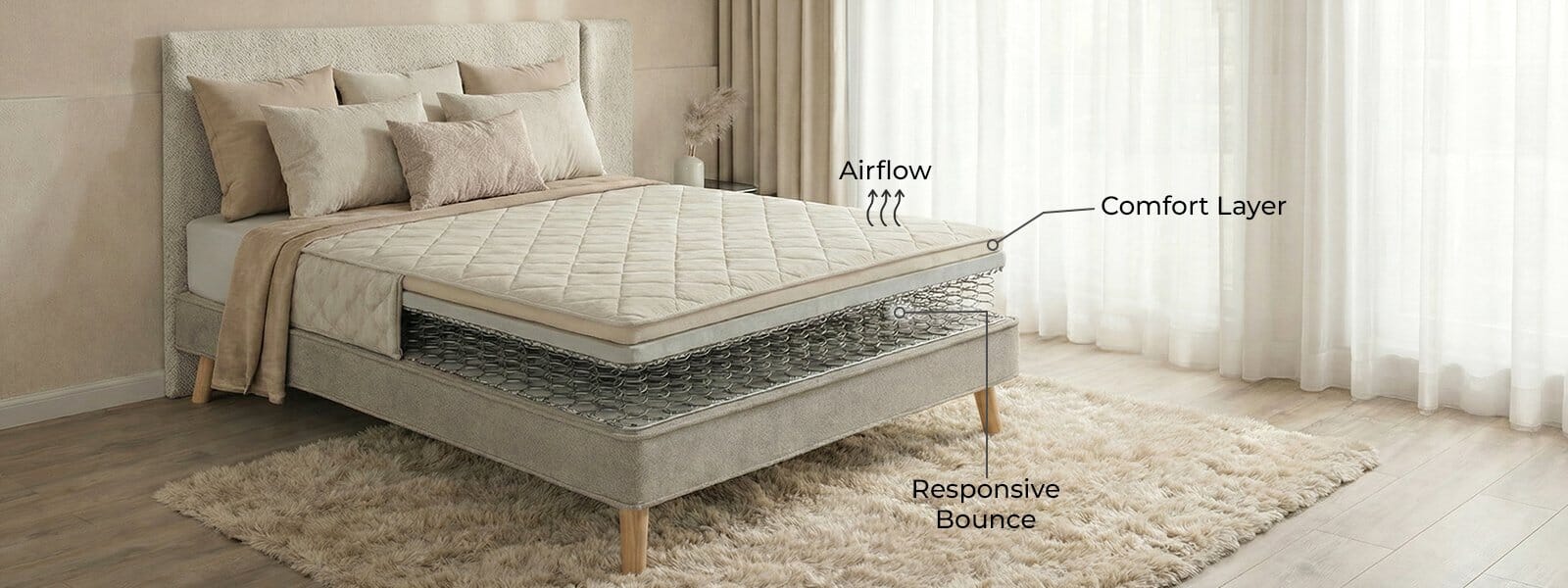
An innerspring mattress is built around a steel-coil support core, wrapped in a soft outer “finish” of fabric and padding. Above the coils sits a comfort stack, often fiber padding (like cotton or wool), foam, or a blend of both, designed to add cushioning and a touch of contouring without the deep sink many people associate with memory foam. The result is a more traditional, on-the-bed feel with structure underneath and softness on top.
Types of Springs/coils (and how they feel)
a) Bonnell coils: Classic hourglass-shaped coils. Often budget-friendly, it can be soft or firm depending on the wire gauge
b) Pocketed coils (Marshall coils): Coils are individually wrapped, so they move more independently. Typically quieter, with better motion control and more targeted support.
c) Offset coils: Hourglass-like coils with flattened edges that act like hinges, offering a firmer, more supportive response when pressure increases.
d) Continuous coils: Formed from a single wire shaped into a row and linked together. Durable and supportive, but less adaptive to body contours.
Pros
– Responsive, buoyant feel that makes movement easier.
– Airflow through the coil core can help with cooler sleep compared to solid foam designs.
– Often more budget-friendly than hybrids and specialty foam builds.
– Firmness options vary widely depending on coil gauge, height, and comfort-layer materials.
Cons
– Pressure relief can be less effective if the comfort layers are thin or basic.
– Motion transfer can be more noticeable, especially in non-pocketed coil designs.
– Coils may wear unevenly over time in lower-quality builds, reducing long-term consistency.
– Some models may need periodic rotation to keep the surface feeling even.
Hybrid
A hybrid mattress is built in layers: a coil base at the bottom for structure and lift, topped with a comfort layer such as memory foam, latex, polyfoam, or a combination. This stacked design aims to deliver a middle-ground feel, cushioning on the surface without losing the steady support of springs underneath. Many hybrids include more than one comfort layer (sometimes with cooling or breathable foams) to fine-tune pressure relief and temperature control.
Pros
– Pressure relief from the comfort layers without giving up underlying back support.
– Coils promote airflow, which can help regulate temperature.
– Often quieter than classic connected-coil innersprings due to modern coil systems and foam layers.
– Balanced feel that is often softer than traditional innerspring but less sinky than many all-foam builds.
Cons
– Usually more expensive than basic foam or innerspring mattresses.
– Motion transfer can still be noticeable, especially compared with high-density all-foam beds.
– Heavier than many other mattress types, making setup and moving more difficult.
Latex
A latex mattress is built from layered latex foam, with comfort layers on top and sturdier support layers underneath. The latex itself can be made from natural rubber tree sap, synthetic latex, or a blend, and the layers work together to cushion the body while maintaining a gently springy, lifted feel.
Types of latex mattresses (and how they feel)
a) Dunlop latex: Latex is poured into a mold in a way that tends to create a denser, firmer base with a softer feel closer to the surface.
b) Talalay latex: Made using a process that produces a more consistent, uniform feel, often experienced as lighter and more evenly plush.
Pros
– Durable material that holds its shape well over time.
– Responsive cushioning that reduces pressure without a deep sink.
– Often sleeps cooler than dense memory foam because it is less heat-trapping by design.
– Distributes weight more evenly, which can help limit the “stuck” feeling some foams create.
– Strong option for shoppers looking to avoid memory foam; natural latex options can appeal to eco-focused preferences.
Cons
– Usually more expensive than standard foam mattresses.
– More bounce can mean slightly more motion transfer than slow-response memory foam.
– Buoyant feel is not ideal for sleepers who prefer a close, body-hugging cradle.
Adjustable
An adjustable mattress is designed to flex and move with a motorized bed frame, shifting smoothly between flat, elevated, and reclined positions. These mattresses are typically made with latex or foam layers (often memory foam) because those materials bend without losing shape or support. Some setups also include comfort-driven features like massage or heat, depending on the base and model. The key idea is flexibility: a mattress that stays comfortable whether the position is for sleeping, reading, or relaxing. They’re available as a single-piece mattress or a split design that lets each side adjust independently, which is especially useful for partners with different comfort preferences. To get the full benefit, an adjustable mattress must be paired with a motorized adjustable bed frame.
Pros
– Works with changing positions, from sleep to lounge, without compromising comfort.
– Can support more personalized sleep setups, especially for people who spend more time in bed.
– Split styles allow each side to adjust independently.
Cons
– Requires a motorized adjustable bed to function as intended.
– More expensive than many traditional mattress types.
– More components means more complexity than foam or innerspring builds.
– Feel can be less plush unless the comfort layers on top are substantial.
What Size of Mattress Should You Get for Your Bedroom?
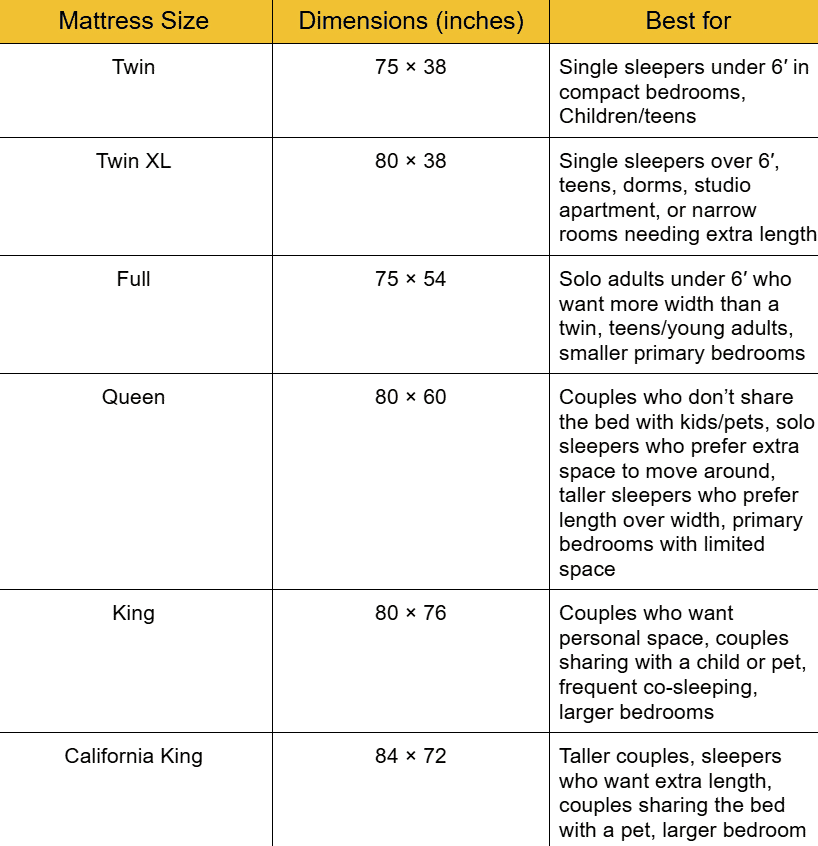
Picking a mattress size comes down to real-life logistics: how much space the bedroom can spare, who’s sleeping in the bed (solo, partner, kid, or the pet who insists on being the third roommate), and a few comfort details like height, sleep position, and overall bedroom dimensions. Below are the standard mattress measurements you’ll most commonly come across, so it’s easy to compare sizes and choose what fits both the room and how sleep actually happens.

How to Choose a Mattress Based on Your Sleeping Position?

Your sleeping position influences how much cushion you need at pressure points and how much support you need to keep your spine aligned. A useful baseline: mattress firmness is commonly discussed on a spectrum, and what feels “medium” to one person can feel “firm” to another depending on body type and comfort preferences.
a) Back sleepers
What you need: Balanced, end-to-end support that keeps the neck, shoulders, and torso aligned while maintaining the spine’s natural curve, without letting the hips sink too far.
Often works well: Medium to medium-firm, depending on body weight and comfort layer design.
Tip: If you wake up with lower back tightness, your hips may be sinking too much or your lumbar area isn’t being supported.
b) Side sleepers
What you need: Pressure relief at shoulders and hips, plus enough support to keep the spine straight rather than dipping.
Often works well: Medium to medium-soft comfort feel (again, varies by body type).
Tip: Shoulder pain often means “too firm” or not enough comfort layer; hip pain can mean “too firm” or misalignment from sinking unevenly.
c) Stomach sleepers
What you need: Strong support to prevent the hips from sinking and pulling the lower back into an uncomfortable arch. If the surface is too soft, the midsection can dip too far, which may throw alignment off and trap more heat around the body.
Often works well: Medium-firm to firm, with thinner comfort layers.
Tip: If you wake up with low back pain, the mattress may be too soft under your midsection.
d) Combination sleepers
What you need: A responsive surface that supports multiple positions without feeling “stuck.”
Often works well: Medium to medium-firm hybrids or responsive foams/latex.
Extra note: Sleeping posture affects alignment and aches. Cleveland Clinic emphasizes that the “best” position varies by person and that alignment matters.
How Can You Tell if a Mattress is Right for You?
– Support keeps alignment steady: A good mattress keeps the spine aligned through the night, so mornings don’t start with that stiff, achy feeling. Support isn’t just “the mattress,” it’s how the mattress responds to body weight, weight distribution, and sleep position, so the right feel can change depending on whether side or back sleeping is the default.
– Alignment feels natural: In the usual sleep position, the spine should feel supported, not bowed (too soft) and not forced (too firm).
– Pressure stays low: After 10–15 minutes on the side, shoulders and hips shouldn’t feel pinched, sore, or numb.
– Morning is the truth test: Waking up looser or neutral is a good sign. New aches, especially in the lower back or shoulders, is a red flag.
– Temperature stays comfortable: If overheating becomes more frequent than before, the mattress may be trapping heat.
– Movement isn’t a problem: Changing positions shouldn’t feel like escaping quicksand, and a partner’s movement shouldn’t jolt sleep (for shared beds).
– Comfort improves over a short trial: Give it at least 2 weeks when possible, since the body can take time to adjust and materials can break in.
Conclusion
Once the right modern mattress is figured out, sleep stops feeling like a nightly negotiation. The room gets quieter, the body settles faster, and mornings feel less like a stretch-and-recover routine. With that foundation in place, the fastest way to elevate the entire experience is the layer that actually touches you. Bedding is where comfort becomes personal: how cool the Sheets feel, how weightless or cocooning the Duvet is, how supportive the pillow is when you settle in. Orchids Lux America is built around those finishing details, luxury bedding designed to refine the feel of the sleep setup and make a great mattress feel even better.
FAQs
How high of a coil count is good for an innerspring vs hybrid mattress?
For a queen-size innerspring or hybrid mattress, a coil count in the 600 to 1,000 range is often a solid benchmark. Higher counts (sometimes up to around 1,200) can add a bit more contouring and support, but only when the coil system and materials are high quality. The smartest approach is to treat coil count as one clue, then weigh it alongside coil gauge, zoning, and the comfort-layer build, not as the single deciding number.
What mattress type works for most sleepers?
Many sleepers do well with a hybrid because coils provide support and airflow, while comfort layers provide pressure relief.
Is a firmer mattress always better for back pain?
Not always. Firmness is only one factor, and too-firm surfaces can create pressure points. Support and alignment matter most, and firmness is commonly discussed on a 10-point scale.
What size mattress is best for couples?
A queen works for many couples, but a king can reduce sleep disruption for restless sleepers or households with pets sharing the bed.
How can it be told if a mattress is too soft?
Common signs include hip sink, a hammock feeling, and morning lower back discomfort.